Beam Book. Your space to reflect, focus and grow.
Order your copyHR Research
How Compensation Affects Mental Health

When we talk about mental health in the workplace, the same themes usually dominate the conversation: stress, workload, burnout, toxic managers, or lack of work-life balance. And while these factors absolutely matter, they’re not the whole picture.
One area that is often overlooked in conversations about employee well-being is compensation. We tend to separate the two topics: mental health is seen as something shaped by “soft” workplace experiences like autonomy or purpose, while compensation is viewed as a purely financial matter driven by benchmarks and cost of living.
In reality, however, compensation and mental health are deeply connected. But the relationship is far more nuanced than simply “higher salary equals happier employees.”
“Compensation and mental health are deeply connected.”
In a context of inflation, economic uncertainty, and rising living costs, financial worries directly affect how secure people feel in their everyday lives.
Data reflects this connection.
In a survey of U.S. workers, the Society for Human Resource Management (SHRM) found that pay and compensation were the second biggest source of workplace stress, with 42% of respondents saying compensation contributes to their stress at work. At the same time, only 34% said compensation contributes to their sense of fulfillment at work.
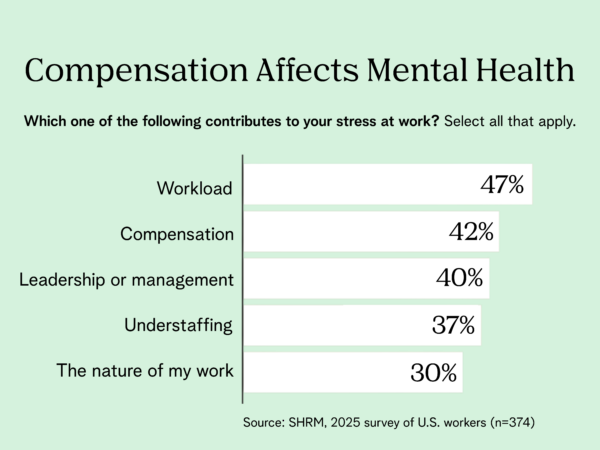
This tells us something important: compensation is linked with employees’ mental health, but not necessarily in the way organizations often assume. Simply increasing salaries is not always enough or, indeed, possible. Employees also care deeply about fairness, transparency, predictability, and their ability to feel financially confident and secure.
So, what can HR leaders do to support mental health through compensation and rewards?
1. Increase the fairness of the compensation strategy
A strong source of negative feelings at work is the perception that compensation is unfair.
Employees constantly compare their rewards to those of colleagues, industry peers, or the effort they put into their work. When compensation decisions feel inconsistent, arbitrary, or biased, it can create frustration, resentment, and anxiety.
Employees who perceive compensation systems as fair are more likely to feel respected, valued, and psychologically secure.
Fairness in compensation goes beyond salary levels. It includes:
- Consistent criteria for promotions and raises
- Equal pay for equal work
- Clear alignment between performance and rewards
- Regular reviews of pay equity across teams and demographics
- Transparent salary bands or compensation frameworks
For HR leaders, improving fairness often starts with asking difficult but necessary questions:
- Are compensation decisions applied consistently?
- Do employees understand how pay decisions are made?
- Are there hidden inequities within the organization?
- Do managers have the tools and guidance to discuss compensation fairly?
Even small improvements in perceived fairness can reduce uncertainty and build trust.
2. Be transparent about how and what gets rewarded
Compensation becomes a source of stress when employees feel like they are navigating a black box. Not knowing what gets rewarded and why increases uncertainty, which can lead to growing anxiety.
Transparency, on the other hand, creates predictability. Employees want clarity around what is valued and how decisions are made.
This means communicating openly about:
- What performance or behaviors are rewarded
- How salary reviews are conducted
- What factors influence bonuses or promotions
- How employees can grow financially within the organization
Importantly, transparency also reduces the emotional burden placed on managers. Many leaders avoid compensation conversations because they feel uncomfortable or unequipped to explain decisions. But avoiding these discussions often increases confusion and stress for employees.
HR can play a critical role by equipping managers with clear guidelines, communication tools, and training on how to discuss compensation confidently and empathetically.
When employees understand the system, they are more likely to perceive it as fair, even when outcomes are not always in their favor.
“Compensation becomes a source of stress when employees feel like they are navigating a black box.”
3. Provide financial education as a benefit
Financial stress does not only depend on how much employees earn. It is also shaped by how confident people feel in managing their finances.
This is where financial education can become a meaningful well-being benefit.
Organizations increasingly support employees by offering:
- Access to financial advisors or coaching
- Education on budgeting, investing, or retirement planning
- Resources for managing debt or major life expenses
- Guidance during periods of economic uncertainty
Providing these resources sends an important message: the organization recognizes that employees are whole people with financial realities that affect their well-being.
Financial education also helps employees regain a sense of control, which is linked to reduced stress and improved mental health.
Compensation is about more than money
Compensation will probably never be the first thing that comes to mind when discussing workplace mental health. Yet financial security, fairness, and predictability shape how employees experience work every single day.
“Reward systems also communicate value, trust, and stability.”
For HR leaders, this means looking beyond compensation as simply a transactional exchange. Rewards systems also communicate value, trust, and stability, all of which contribute to mental well-being.
Sources
SHRM 2025 Insights: 𝘞𝘰𝘳𝘬𝘱𝘭𝘢𝘤𝘦 𝘔𝘦𝘯𝘵𝘢𝘭 𝘏𝘦𝘢𝘭𝘵𝘩

Iulia Cioca
HR Scientist