Beam Book. Your space to reflect, focus and grow.
Order your copyActua
HR for the Future: Start with Context
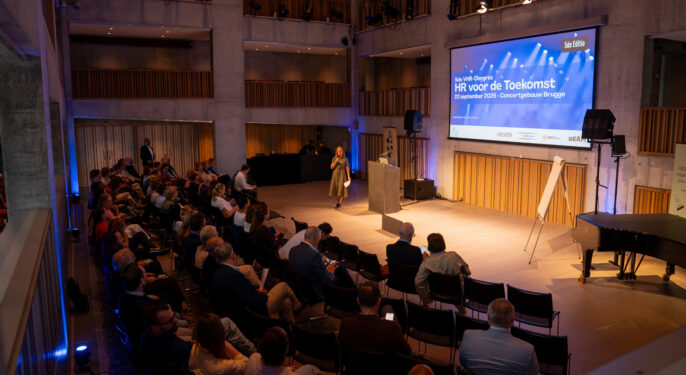
Context shapes much of our behaviour. That was the starting point of the fifth VHR Congress at Concertgebouw Brugge.
As in previous editions, Frank Vander Sijpe (Securex) opened with an overview and a framework for the other presentations: first the context, then the behaviour and challenges that emerge from it, and finally HR's response.
1. Context: outside and inside the organisation
The Belgian labour market is cooling, but remains tight. Population ageing and skills mismatches persist, while people starting their careers face pressure. Meanwhile, labour costs are rising, and geopolitical developments and the impact of AI are creating uncertainty.
Danny Van Assche (VBO) highlighted how much labour potential remains untapped. In the second quarter of 2026, Belgium’s employment rate among 20- to 64-year-olds stood at 72.8% (Statbel), against a target of 80%. Regional differences are substantial: 77.3% in Flanders, 67.6% in Wallonia and 64.7% in Brussels.
Within organisations, we create context too. We decide how to structure the organisation and its work, how to lead and what to measure. Those choices influence our behaviour.
2. Behaviour: what do we observe, and what do we encourage?
In the labour market, employees seek greater job security and are less inclined to change jobs. Employers recruit more cautiously and expand their flexible workforce. Governments focus on bringing more people into work, extending working lives and supporting a return to work after illness.
More cautious hiring does not make shortage occupations disappear. Flanders has 227, Brussels 103 and Wallonia 144. Employer branding therefore remains relevant. Julie Haspeslagh (Ghent University) discussed continuous authentic storytelling: keep sharing genuine employee stories with the people you want to attract.
Within organisations, what we measure is one of the choices that shape behaviour. Anke Ulens (Copus) and Koen Lambrechts (Vivaldis Interim), authors of De meeste mensen willen werken (“Most people want to work”), highlighted the influence of KPIs. Which KPI do we choose, and what will it encourage people to do more or less of?
People focus on what you measure. But activity is not the same as value.
When someone gets stuck, we often look at the person first. But what in the work or the organisation keeps that behaviour in place?
3. Three connected challenges: wellbeing, talent and productivity
The context and the behaviour it generates connect to three challenges Frank identified: wellbeing, talent and productivity.
When people are off sick, pressure increases on those who remain. That makes it harder to keep people healthy at work and retain talent, while putting productivity under strain. And Belgium needs substantially higher productivity growth.
Finding more people is not enough: creating more value with the resources available is what counts.
Not the most cheerful picture. Fortunately, the congress went beyond the diagnosis. How do we create that value and help people stay in work sustainably, without asking them to work harder?
4. The HR response: entrepreneurial HR
Addressing these challenges calls for entrepreneurial HR. That means helping to shape the context inside and outside the organisation, as well as responding to it. The speakers showed what this means for how we organise ourselves, who does which work and the conversations we have.
How we organise ourselves
Jan Van Raes and Dries Vanhecke (UZ Brussel) showed how they reorganised their HR team. HR moved from a functional to a more client-focused structure, with teams serving medical departments, patient care and support services. HR attends team meetings and hears directly what those services need.
Start with the business. Not with what HR offers.
Prof. Peggy De Prins (Antwerp Management School) warned that the pendulum can swing too far when organisations adopt new models. Flatter, more decentralised structures can leave people without the clarity or support they need. What works depends on the context. The ability to read that context is what she calls contextual intelligence.
Who does which work
How we organise ourselves is linked to who does which work. Kristel Seymus (Orvia) contrasted talent first with impact first. In her comparison, the starting point shifts towards the result that is needed. A small permanent core works with external partners according to the expertise and capacity required.
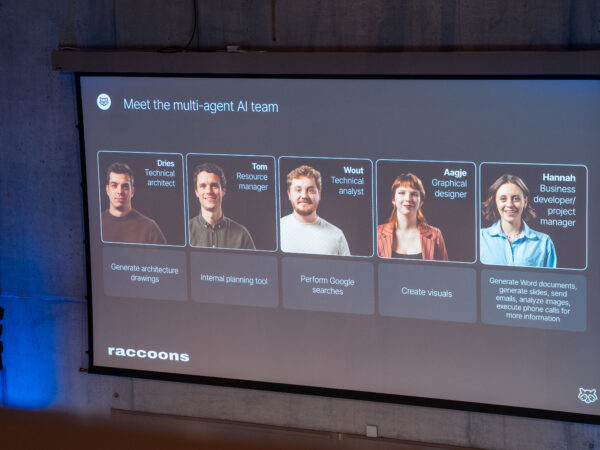
Alongside employees and external partners, AI agents can take on part of the work. Michiel Vandendriessche (Raccoons) gave an impressive demonstration of agents communicating with one another and working through an HR case for a client almost independently. Frank drew a clear boundary:
AI for people, with people, but not above people.
Anke Ulens and Koen Lambrechts highlighted the importance of a mix of simple and demanding tasks. If AI takes over the simple tasks, will enough variety remain in the job?
The conversations we have
The internal context also shapes what people feel able to say. In her book The Dark Side, Peggy De Prins explores what remains unspoken at work. She shared figures showing that in 2024, 26% of employees did not speak up, even when they had good ideas. In 2021, that figure was 38%.
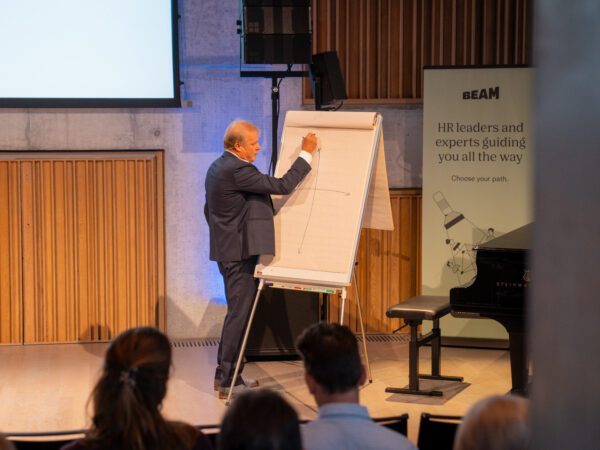
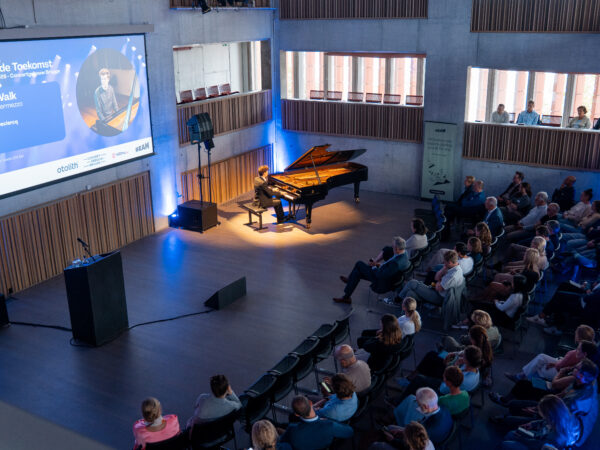
David Ducheyne (HRPro, VHR, Otolith Consulting) used a striking musical comparison to illustrate why dissonance matters in the workplace. At the piano, he let us hear how tension calls for resolution.
We do not create progress by eliminating dissonance. We create progress by turning dissonance into resolution.
Kristel Seymus discussed the uncomfortable conversations leaders need to have themselves. She distinguished between soft love, telling someone what they want to hear, and tough love: “I tell you what you need to grow, even when it is uncomfortable. Precisely because I believe in you.”
If we want different behaviour, the best place to start is the context that helps shape it.
Thank you to VHR and all the speakers, to Jens Allaert for the photos and to Alexander Declercq for the wonderful musical interlude.
Beam was pleased to be a partner once again, alongside Otolith Consulting, Concertgebouw Brugge and HRPro.
In fond memory of Vincent Delbaere, one of the driving forces behind the congress.
See you at the HRPro Congress?
Change is part of everyday life in HR. Yet change management remains a challenge, while our own profession is evolving too. That is the focus of the annual HRPro Congress on 19 November 2026 at the VBO Conference Center in Brussels. A half-day to explore what lies ahead with experts and fellow HR professionals. We hope to see you there!
Edward Vanhoutte
Managing Partner