Beam Book. Your space to reflect, focus and grow.
Order your copyHR Research
Work Design: Why 'More' Is Not Always Better

“How would you fix this wobbly bridge?”
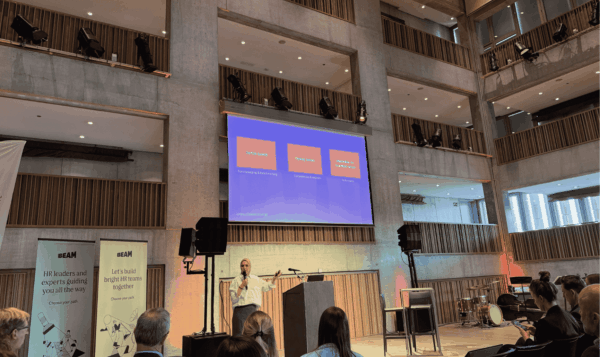
Professor Giverny De Boeck asked during her session at Vlerick HR Day.
“By adding an extra block to the shorter column,” I said, just like almost everyone else in the audience.
Her reply immediately put things into perspective:
“By the time you’ve found that block, you could also have removed one from the taller column.”
With this LEGO metaphor, Prof. De Boeck (IÉSEG School of Management) illustrated the principle of additive bias: our human tendency to solve problems by adding things.
That tendency also shows up in how we design work.
Treating symptoms vs. addressing root causes
Conversations in HR frequently revolve around engagement, burnout, retention and well-being. Yet the underlying design of the work itself rarely gets the same attention.
Good work design is a powerful strategic lever. It addresses root causes rather than simply treating the symptoms.
In essence, work design is about how tasks, responsibilities, autonomy and collaboration are organised. These choices fundamentally affect performance, motivation and well-being.
Research by Prof. Sharon Parker and her colleagues shows that getting the design of work right helps create meaningful and motivating work.
The trap of ‘good’ resources
The well-known Job Demands-Resources (JD-R) model teaches us that work consists of job demands and job resources. The natural reflex is often to reduce demands and increase resources, but the reality is more nuanced:
- Too much of a good thing backfires. Autonomy is great, until it crosses into ambiguity or makes it difficult for employees to disconnect.
- Healthy pressure drives growth. A stretch challenge isn’t inherently negative. It is often the exact trigger for learning and motivation.
As illustrated in the LEGO exercise, our instinct is to add. But adding resources is not always the answer. Nor is removing every demand. The goal is to find the right balance.
What does good work look like?
If more is not always better, how do you decide which job resources and job demands deserve attention? The SMART Work Design framework offers a useful compass here.

Good work combines four types of job resources:
- Stimulating (variety and challenge)
- Mastery (clarity and feedback)
- Agency (autonomy and control)
- Relational (social connection and support)
At the same time, job demands should remain Tolerable (manageable workload, limited role conflict and limited work-home conflict).
How can organisations redesign work?
Now we know what good work looks like, how do we make it happen? Two complementary approaches emerged during the session.
- Top-down: Organisations can redesign work through strategic work redesign (structurally redesigning jobs at organisational level) or job carving (rearranging work to create more tailor-made roles).
- Bottom-up: Individuals and teams can shape work through job crafting (proactively adjusting aspects of their work to better fit their strengths and needs).
Bringing it to life
Practical cases from Pieter-Jan De Man (STAS) and Jan Bouwen (Argenta) brought these principles to life. They showed how much progress can already be made by reducing complexity.
Also important: start from the problem you are trying to solve and the business needs behind it, not from a model. Models are a means to an end, not an end in themselves.
A personal note
What makes this topic particularly relevant today is the changing labour market context. Long-term absence continues to reach record levels, while labour scarcity is expected to increase further as demographics shift.
In that context, work design, together with organisation design, is moving from important-but-not-urgent to crucial and immediate. We simply cannot afford poorly designed work anymore.
It can start by removing a LEGO block.
Want to dive deeper?
🎬 Watch the Beam Talk
You can watch the recording of our recent Beam Talk on work design with Eva De Winter.
📚 Explore resources
For additional evidence-based resources, visit the Centre for Transformative Work Design.
🎓 Join a learning programme
Interested in a more structured learning journey? PUC-KU Leuven Continue offers a programme on work design taught by Eva De Winter and Prof. Geert Van Hootegem. Discover the programme.
Picture: Nature

Edward Vanhoutte
Managing Partner