Beam Book. Your space to reflect, focus and grow.
Order your copyActua
Rethinking Organisation Design. And HR.
We designed organisations for a labour market with abundant supply.
That world no longer exists.
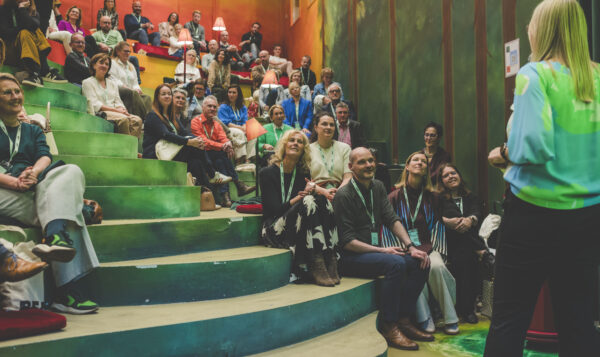
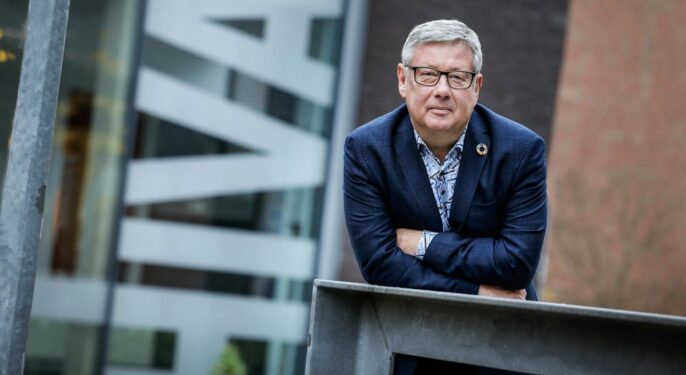
During our recent Beam Talk, Professor Geert Van Hootegem (KU Leuven) reflected on one of the most pressing organisational challenges today, but also one of the biggest opportunities: reinventing how work is organised in a context of structural labour scarcity.
A shift that has been building for years
The labour market situation we are facing today did not appear overnight, nor is it a temporary fluctuation.
The working-age population is gradually shrinking. More people leave the labour market than enter it. This demographic shift fundamentally changes the context in which organisations operate.
The urgent challenge today is reorganising work so it actually fits the people who are available.
When the logic of design no longer fits the context
For decades, organisations were designed around specialisation and standardisation. In a labour market with sufficient supply, that logic worked well.
This logic no longer holds. The more narrowly roles are defined, the harder it becomes to find people. The more work is fragmented, the more coordination, handovers and control are required.
What once created efficiency now creates rigidity.
At the same time, the way work is organised does not always support sustainable performance. People perform better when demanding work is combined with sufficient autonomy. Yet that balance is often missing, contributing to dropout and long-term absence.
Scarcity is therefore not only something organisations face externally. It is also something they partly create through the way work is organised internally.
Rethinking the starting point
If scarcity becomes structural, the principles behind organisation design start to shift.
Traditionally, the job came first. Roles were defined, and people were selected to fit them. That approach becomes difficult to sustain.
Organisations can no longer rely only on rigid structures and narrowly defined functions. Work increasingly needs to be organised around available capabilities, broader collaboration and adaptability.
From specialised units to integrated teams
Instead of organising work around fragmented expertise and fixed functions, organisations can structure work around more integrated teams that take responsibility for a broader part of the process.
By combining complementary skills within teams, organisations reduce handovers, coordination and dependency between separate units. In a context of structural scarcity, this creates more flexibility and resilience.
From functions to flows
Functional silos work best in relatively stable environments. But in more complex settings, they often lead to fragmentation and loss of overview.
Organisations can instead organise work around flows: value-adding processes such as a patient journey, a product line or a client service. For example, instead of passing a client through five separate departments, one integrated team follows the entire journey from A to Z.
This reduces unnecessary coordination and increases ownership. It also makes organisations less dependent on chains of highly specialised roles.
What this means for HR
These shifts have clear implications for HR.
If organisations move away from allocating people to fixed roles, the focus shifts towards mobilising capabilities across the organisation. This requires a broader view of talent: combining more versatile internal roles and integrated teams with specialised external expertise and partners that can be mobilised when needed.
It also requires a different perspective on how work is organised, how autonomy is distributed and how people remain employable over time.
Beyond Human Resources
As labour market realities and the nature of work continue to evolve, HR moves closer to the centre of organisational transformation.
Redesigning organisations is becoming a strategic response to labour scarcity, but also an opportunity to organise work in ways that are more sustainable for both organisations and people.
In that sense, we are no longer speaking only about Human Resources, but increasingly about People & Organisation.
Continue the conversation
Organisation design and work design are closely related, but not the same.
While organisation design focuses on structures and decision-making, work design looks at how work is shaped and experienced in daily practice.
In our next Beam Talk with Eva De Winter (Rewire) on 28 May, we will explore how these ideas translate into concrete interventions in day-to-day work and collaboration.
Edward Vanhoutte
Managing Partner