Beam Book. Your space to reflect, focus and grow.
Order your copyAdvice
Self-Regulation: When the Body Leads the Mind
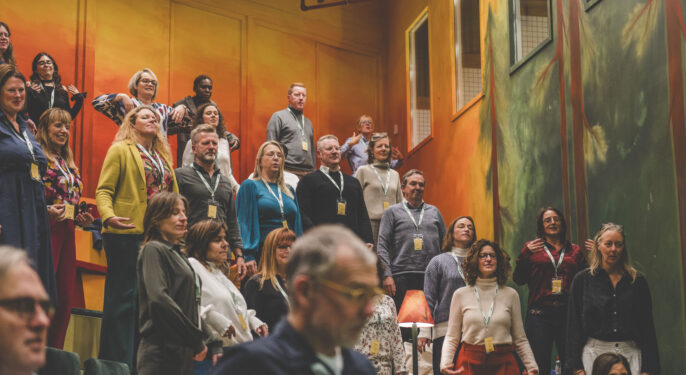
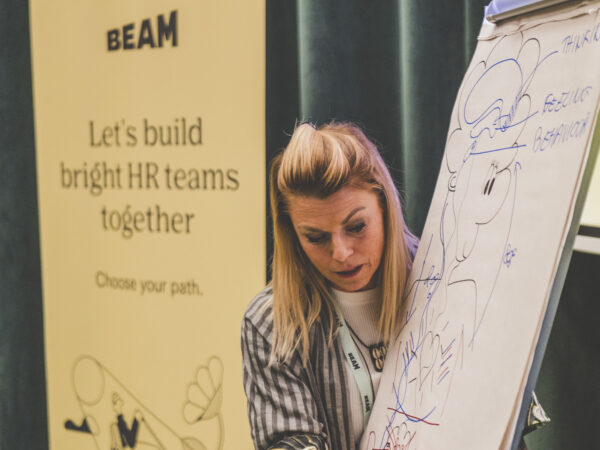
The Beam team was honored to welcome Bernadette Laermans at our recent community event for HR Leaders and Experts. The evening was all about fueling our energy by aligning Body and Mind. When we create balance, we create impact!
Bernadette invited us to pause. Not to disconnect, but to re-connect. She explained how science confirms what ancient wisdom whispered for centuries: our body holds the key to self-regulation, balance and resilience.
Did you know that a healthy nervous system is not always “zen” or calm? It can shift smoothly from action when needed (our sympathetic state) to relaxation when possible (our parasympathetic state). This ability to switch is what we call self-regulation.
Today, many of us deal with heavy workloads, rapid change and a growing sense of uncertainty. When we’re under pressure, our nervous system automatically activates the fight, flight or freeze response. Our heart beats faster, our muscles become more tense and our breathing becomes shallow. But when your body is under that much tension, it can decide to redirect oxygen and glucose away from the brain, more specifically from the prefrontal cortex. Its one goal: to keep you alive. But, this is exactly the part of the brain we need for decision-making, problem-solving, focus, empathy and emotional regulation. When people say “just relax”, your body simply can’t.
It’s not a lack of willpower, it’s physiology.
Bernadette reminded us:
“Your body decides long before the brain does.”
Bodily signals play a central role in how we experience and respond to situations. What we feel physically shapes what we think, decide and do. Our body has a lot to tell, so we better listen.
One of the most important communication highways in our body is the vagus nerve, connecting the brain, heart and all vital organs. When activated through a sense of belonging, calm breathing, eye contact or a gentle voice, it sends a signal to the brain: you’re safe, you can slow down, you can connect. People who can regulate themselves, create safety for others around them.
From knowing to doing
Understanding is one thing. Applying it is another. That’s where Bernadette’s “Magic 7“ comes in: seven simple, practical techniques to help you self-regulate and balance your body and mind.
1. Open body posture
Physically opening your body tells your nervous system: I’m safe.
2. Grounding - creating stability
Place both feet on the floor. Feel your little and big toe, the ball of your foot, the inside and the outside of your heel. This awareness aligns body, mind and heart in one space in the same moment. Another technique is rubbing your hands over your legs or moving your back against the chair.
3. Your senses - an open view
Shift your focus from the screen to what surrounds you, look outside. Listen, observe, smell. Focus. Sensory awareness signals the brain that you’re present and safe.
4. Fascia - release tension
Tap, massage or gently squeeze your muscles. These micro-vibrations release tension stored in your fascia, our connective tissue and highly sensitive to the energy in our environment and in others.
5. Joints - shake it off
Literally. Shake your shoulders, soften your knees. Imagine rope skipping. Take one final breath and release everything at once. Tingling is normal. It’s your bio-electricity when releasing tension. After a difficult conversation, even washing your hands can help to release the tension from the other person and to reconnect with yourself.
6. Find safety
Connect with people you trust, in a community where you feel you belong. Genuine interaction creates safety and increases oxytocin, the hormone that lowers stress. Even humming or making gentle sounds can activate your vagus nerve to give you a calm and safe feeling.
7. Breathe
Not deeper, not with your belly, but more aware. Place both hands in front of your diaphragm, feet and hips grounded and an open body posture. Inhale through the nose and open your hands. Exhale and close your hands. Repeat 3 to 4 times. A long exhale tells your body that it can relax again. Your breath is the remote control of your nervous system.
From self-awareness to self-leadership
Self-regulation isn’t about being calm all the time, it’s about being adaptive. People who sense their own tension, can shift their state and stay connected. That’s how they create safety for others.
Training this doesn’t require hours! It starts with one minute a day: stop, stand still, breathe, observe and reconnect. As she closed her session:
“Find gratitude in every small thing and see this as a lifelong experiment. You’ll never be the perfect master of self-regulation, but you can have a lot of fun practising it.”
At Beam, we couldn’t agree more. Because growth, just like self-regulation, starts from within. And when HR teams shine from within, continuity and impact follow naturally.

Evi Thonnon
Partner