Beam Book. Your space to reflect, focus and grow.
Order your copyActua
What Evidence-Based HR Can Learn from Jamie Oliver
How can we actually get evidence-based HR to land in practice?
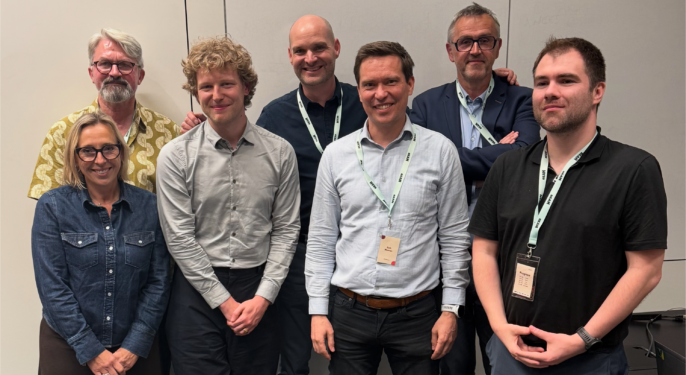
That question ran as a common thread through the second edition of the Evidence-Based HR Masterclass at Vlerick Business School in Brussels. On International HR Day, HRPro once again joined forces with KU Leuven, CEBMa, Beam, Otolith Consulting and #ZigZagHR for an afternoon dedicated to evidence-based HR.
David Ducheyne (HRPro) immediately set the tone: in the rush of daily practice, HR decisions are still often based more on beliefs or opinions than on well-grounded information. That is precisely why HRPro’s mission is so urgent today: helping to professionalise the field and giving HR a stronger, more evidence-informed voice.
The masterclass mainly showed how we can do better: start with better questions, begin small, and translate theory directly into practice.
Start with Jamie Oliver
Professor Rob Briner (CRF, Queen Mary University of London), one of the pioneers and leading voices in evidence-based management, addressed one of the biggest misconceptions around evidence-based HR: the idea that it is too theoretical, too complex and, above all, too time-consuming.
According to Rob, the evidence-based community has partly contributed to that perception itself by sometimes making things unnecessarily complicated.
With his background in both academia and practice, Rob is sometimes described as a “pracademic”. His definition of evidence-based HR is therefore remarkably pragmatic:
A process that leads to better-informed, and therefore more accurate, answers to two fundamental questions:
- What are the most important problems or opportunities for our organisation?
- Which interventions are likely to help?
According to Rob, three simple principles already take you a long way.
1. Combine sources
Scientific research, organisational data, professional expertise and stakeholder input all matter. One important nuance: start with the stakeholders.
2. Follow a structured process
Be careful with “solutioneering”: the human tendency to jump to solutions immediately and then only look for data that confirms what we already believe. Rob also refers to this as “anecdata”.
3. Focus on the most reliable information
Not all information deserves the same weight, nor is all information equally relevant.
So where do we stand today with evidence-based HR? According to Rob, not far enough yet.
The evolution seems to have reached something of a plateau. If we want things to change, a different approach is needed. Rob therefore made a warm appeal to make evidence-based HR more accessible and more workable in everyday practice.
His own suggestion was simple but telling: if you want people to cook more often themselves, you do not start by giving them a highly complex three-star recipe by Paul Bocuse. You start in an accessible way. More Jamie Oliver, less fine dining.
After all, the goal is not to make perfect decisions, but to make better-informed ones.
From principles to practice: “Keep your critics closer”
How do you translate those principles into everyday organisational reality?
Jeroen Camps (Police Antwerp, Thomas More) showed through a recruitment & selection case at the Antwerp police force that this can absolutely be done in a practical way.
His main advice: start small. Evidence-based HR is not a switch you suddenly flip; it is a muscle you gradually train.
Jeroen challenged the audience to ask practical questions linked to the same four information sources Rob had referred to earlier:
- Scientific research: which search terms are we using, and which synonyms are we missing?
- Organisational data: what useful data do we already have available?
- Professional expertise: which experts are we listening to, and how biased might they be themselves?
- Stakeholders: which stakeholders should we involve, and who is likely to resist?
That final point led to a quote many participants will probably remember:
“Keep your friends close, but your critics closer.”
Critics force us to sharpen the quality of our decision-making using the best available data at that moment.
That same focus on diagnosis also returned in the session by Charis Libotton and Dries De Schutter (Knowledge On the Spot). They applied these principles to leadership and organisational development within a local government context, where employees were expected to show more ownership in an environment of growing uncertainty.
Instead of immediately launching a training programme, they first explored what was happening underneath the surface: where collaboration became difficult, which uncertainties were at play, and which assumptions leaders themselves were making.
Their key conclusion was clear: leadership problems are often not individual issues, but are deeply connected to the way the organisation itself is designed.
Behaviour is also a design question
Seth Maenen (Antwerp Management School, Torgo) built further on that idea by zooming in on organisational design and collaboration.
Most organisations run into the same challenge in practice: as organisations grow, coordination between teams quietly becomes more complex.
As teams grow and interdependencies increase, collaboration often becomes more difficult. The reflex? Add more meetings, introduce extra coordination layers or centralise decision-making. In many cases, organisations mainly react to the symptoms, while the underlying structure remains unchanged.
This touches the core of how we should look at organisations: many so-called “people problems” are actually design problems. Too often, we approach challenges as a lack of leadership, culture or engagement, while the way work itself is organised may be just as decisive.
The bottom line
Evidence-based HR does not make the profession colder, more bureaucratic or slower.
Quite the opposite.
By investing a little more time upfront in understanding the problem, organisations avoid wasting valuable energy and budget on interventions that completely miss the mark.
Ultimately, it makes HR both more effective and more human.
So gather your stakeholders, listen to your critics, dare to look critically at your organisational design, and leave French haute cuisine aside for a while.
With thanks to all speakers, participants and partners who contributed to this inspiring edition of the HRPro Masterclass. Special thanks also go to Jeroen Stouten (KU Leuven, CEBMa), who helped shape the substantive foundation of this masterclass, and to David Patient (Vlerick Business School) for the warm welcome.

Edward Vanhoutte
Managing Partner